 |
|
 |
Prospects |
| |
In the second half of the 20th century our country has made tremendous progress with the aim of creating an economically prosperous nation. Japanese industries have especially been producing technologies and products that are accepted as world standard; as a result, we now can enjoy a comfortable life. But on the other hand, technology that supports society is composed of various elements that are tricately interrelated and which have grown in complexity compared to several decades ago. We are now at a point where we can not imagine how much the technology affects the whole society even when one function of the technology stops temporarily.
Actually, in the last ten years we have experienced a variety of serious technological disorders due to break-downs in the transportation system, energy supply system, communication network, etc., that were brought about by nature and/or by man-made disasters. Measures taken to avoid nuclear power plant accidents would be the most important problem that requires an urgent solution.
The NDE and Science Center at Iwate university was established in the beginning of the 21st century with the intention of maintaining the infrastructure and preserving the environment. Its other intentions are to protect life and assets for the future as well as contribute to human peace through engineering.
|
|
 Contents in this page Contents in this page |
|
|
| |
Symbol
 |
Basis of NDE is expressed by five colors that surrounds the earth.
Purple: Truth, Blue: technology, Green: education, Yellow: association,
Pink : future
|
|
|
Concept |
| |
Structures of metal have a life span similar to human beings. Present scientific techniques are able to extend the life span of structures but not permanently. Comparing a structure to a human being and supposing the average life at 80 years, material degradation advances at the beginning of its use, cracks appear at the age of 50 and finally, metal breaks down at the age of 80.
There are many research centers in the world that are studying the prediction of the life span of structures. However, the research that has been done up to now has been confined to discovering cracks. The reason why accidents of metal fatigue never cease to occur, is because fractures are produced by a big shock such as an earthquake even before the appearance of cracks. At our center we study material degradation from the very beginning of its use up to the appearance of cracks non destructively. And we intend to carry out research to predict the time of appearance of cracks.
In short, traditional research is something like the prevention of diseases
that occur after 50 years when the aging process starts. The research we
are conducting is equivalent to health care given from infancy to old age.
For the first time anywhere in the world our center is thus conducting
cutting-edge research. |
|
 |
 |
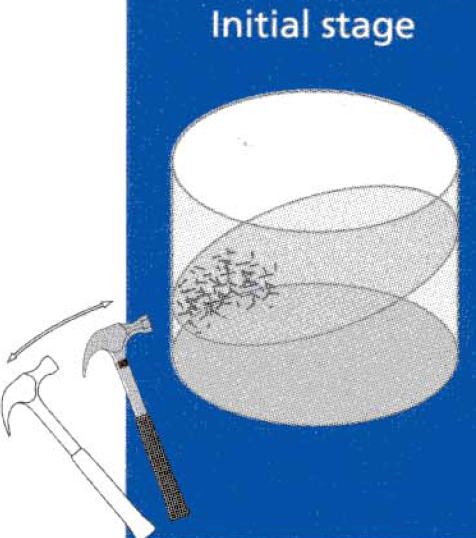
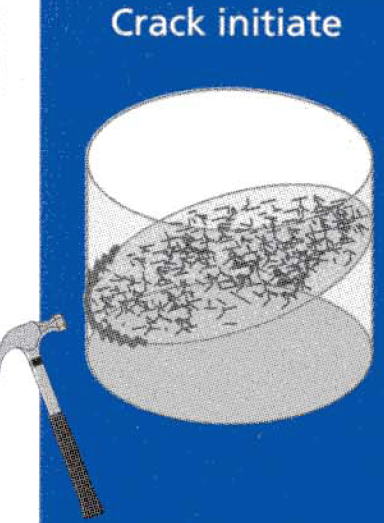
| 1. Initiation and multiplication of dislocation |
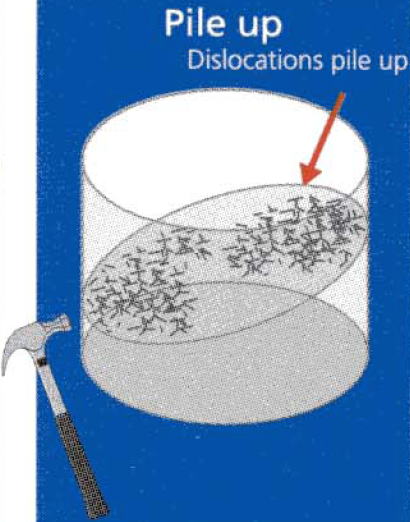
2. Pile-up and anchoring of dislocation |
| |
|
 |
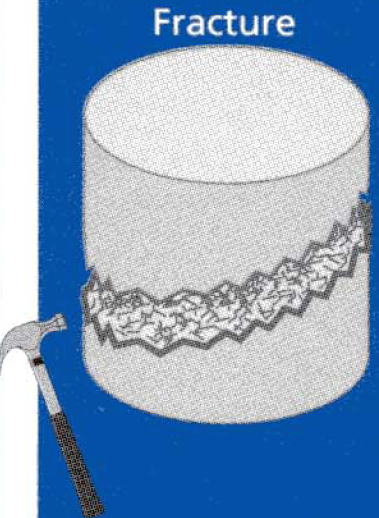 |
| 3. Initiation and propagation of cracks |
4. Rapid spread of cracks resulting in fracture |
|
|
Non Destructive Evaluation |
| |
With the passage of time external forces cause dislocations to accumulate
in the metal. In general, this is called metal fatigue and in the future
the study of metal degradation will be generating much interest.
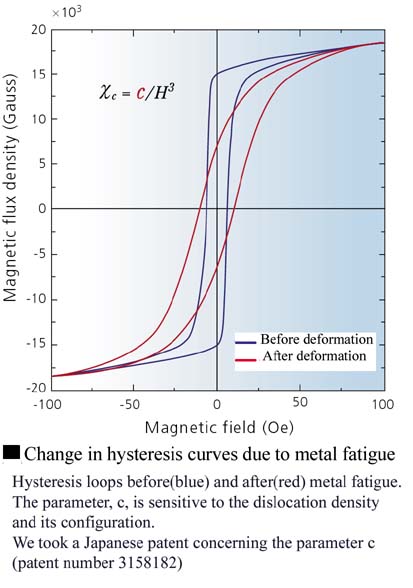
For the last 30 years, the Faculty of Engineering at Iwate University has carried out pioneering work on the relationship between magnetism and dislocations that indicate metal degradation. As a result, it has been found that there is a close relationship between the state of metal degradation and magnetism. If the relationship between magnetism and the mechanism of degradation can be clearly established then metal degradation can be predicted by measuring magnetic properties.
Iwate University and the Max-Planck Institute in Germany are the only institutions in the world that have been actively involved in this type of research.
|
|
|
|
Education |
| |
The safety of society is expected to be developed as a new field of study in the 21st century. Although non destructive evaluation technology has just started, our center will develop the technology to take the lead in making it available for society.
At the same time our aim is not only to provide the information that has
been gathered at Iwate University and the Max-Planck Institute to the next
generation, but also to train the young people so that they will be able
to contribute to society. We hope students will acquire great insights,
a broader outlook and abundant internationalism while researching and by
working hard in cooperation with local and foreign esearchers.
|
|
|
|
 |
|
(c) 2005. NDE & SRC all rights reserved.
|